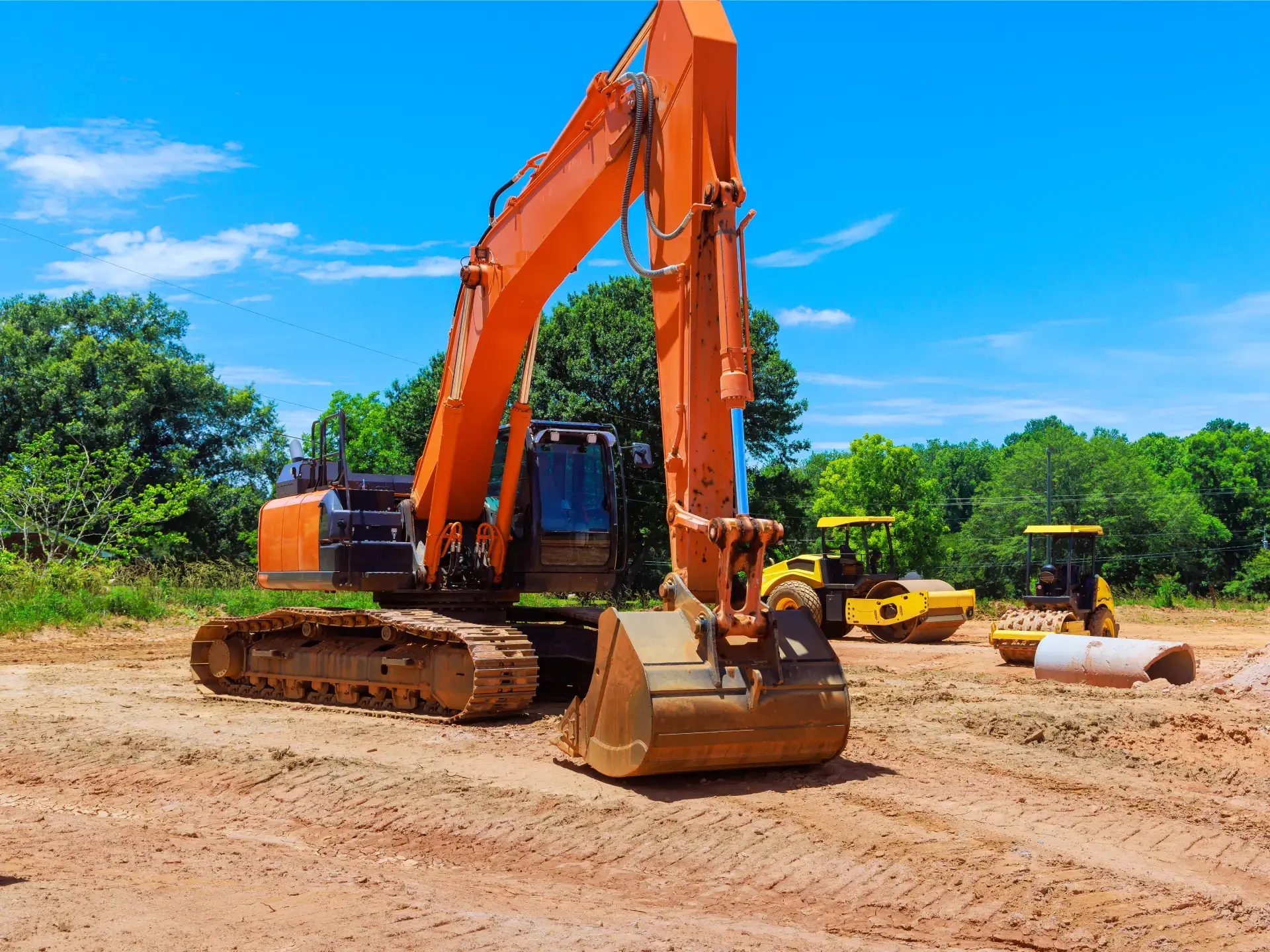
The main equipment used for land clearing includes excavators, bulldozers, skid steer loaders, and brush cutters. Each machine handles a different part of the job — and the combination your contractor brings to your property should match what’s actually growing there and what you plan to do with the land once it’s clear.
If you’ve gotten a quote from a land clearing contractor and wondered what all those machines actually do, this breakdown is for you.
Why Equipment Selection Matters More Than Most People Realize
Choosing the wrong equipment for a clearing job doesn’t just slow things down — it can leave your land in worse shape than when the crew arrived. Heavy equipment on the wrong terrain compacts soil, creates ruts, and damages the ground structure you’ll need for grading or construction later.
On a recent project in Grimes County, we walked a property that had been partially cleared by another contractor using only a brush cutter. The mesquite and cedar came down fine, but a section of large post oaks near the back of the tract hadn’t been touched — the equipment couldn’t handle them. The landowner ended up paying twice: once for an incomplete job and again to bring in the right gear to finish. Matching the machine to the vegetation and terrain from the start is how that situation gets avoided.
Here’s a look at the core equipment used in traditional land clearing — what each machine is, what it does well, and where it fits in a typical Central Texas clearing job.
Did You Know? Earthmoving equipment — the category that includes excavators, bulldozers, and wheel loaders — accounts for roughly half of all U.S. heavy construction equipment market volume, driven by demand for excavation, grading, and land-clearing work across residential, commercial, and infrastructure projects.
Excavators: The Workhorse of Heavy Land Clearing
What an Excavator Does
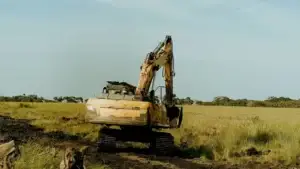
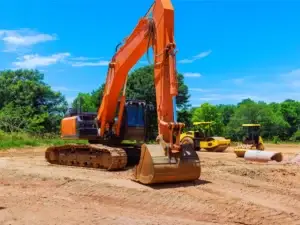
An excavator is a tracked machine with a long hydraulic arm and a digging bucket. In land clearing, it’s used to grab and pull trees at the root, lift and move large debris, extract stubborn stumps, and clean up material that bulldozers have pushed into piles.
For large hardwoods — the kind of post oak, water oak, and live oak common throughout Grimes, Walker, and Brazos County — an excavator is often the only machine that can pull the root mass out cleanly. Push a big oak with a dozer and you’ll knock it over, but the root system still sits just under the surface, which creates problems later when you’re grading or compacting.
When Excavators Are the Right Call
Excavators shine on properties with large trees and significant root systems. They’re also the go-to for clearing near structures, fence lines, or areas where precision matters. A skilled operator can work an excavator in tighter spaces than a bulldozer.
At 3H Construction, our excavators handle most of the heavy tree work on our clearing projects. The machine we use depends on the acreage and what’s growing — smaller excavators for tighter residential tracts, larger machines for open agricultural land with big canopy trees.
Bulldozers: The Ground Movers
What a Bulldozer Does
A bulldozer uses a wide front blade to push material across the surface. On a clearing job, it pushes trees, brush, and debris into piles. It also starts the process of breaking up root zones and leveling rough terrain.
Bulldozers are fast and efficient on open ground. They cover a lot of land quickly and can handle moderate-sized trees, stumps, and dense brush without slowing down. The tradeoff is that they’re less precise than an excavator and can cause more surface disruption.
When Bulldozers Do the Work
Dozers are most valuable on larger, more open tracts where the goal is to move material quickly. For a 10-acre pasture full of cedar and mesquite, a dozer can push and pile debris in a fraction of the time an excavator would take. On heavily wooded tracts with mixed vegetation, the two machines often work together — the dozer pushes the mid-size material while the excavator handles the big trees.
Pro Tip: If your cleared land is headed straight into grading and site prep, talk to your contractor about how the bulldozer work is done. Aggressive dozing that strips too much topsoil in the wrong places can cause headaches during grading. Good crews think ahead.
Skid Steer Loaders: Tight-Space Specialists
What a Skid Steer Does
A skid steer is a compact, highly maneuverable machine that accepts a variety of attachments — buckets, grapples, brush cutting heads, and stump grinders. In clearing work, it handles cleanup, debris removal, and smaller trees in areas where larger equipment can’t safely operate.
Skid steers are common on residential lots and properties with limited access. They can also clear a brush-heavy area quickly when paired with the right cutting attachment — especially useful on properties with thick cedar or underbrush beneath a larger tree canopy.
Skid Steers in a Central Texas Context
In Central and Southeast Texas, skid steers regularly appear in clearing crews handling residential acreage, creek-side clearing, and properties with trees close to existing structures. Their tight turning radius makes them useful in spots where a bulldozer would cause damage.
Did You Know? The first skid steer was invented in 1957 by brothers Cyril and Louis Keller in Rothsay, Minnesota — built specifically to clean turkey manure from the tight, low-clearance spaces of a local farmer’s barn. That original design logic, a compact machine that turns within its own footprint, is exactly what makes skid steers valuable on residential clearing jobs today.
Brush Cutters and Mulching Heads
What Brush Cutters Do
Brush cutters are typically mounted on skid steers or tracked machines. They use high-speed rotating drums with cutting teeth to shred brush, small trees, and tall grass. The result is mulch left on the ground surface.
These attachments are effective for light to moderate vegetation — cedar, native brush, and small-diameter trees. They’re fast and relatively cost-effective for pasture reclamation.
What 3H Does — and Doesn’t — Use Them For
This is a point worth being direct about: 3H Construction does not do forestry mulching. Forestry mulching leaves all that processed vegetation on the ground as a mulch layer. That approach works for some ranchers who want fast pasture reclamation, but it’s not appropriate for land that’s heading into grading, site preparation, or house pad construction. Decomposing organic material beneath future construction creates settling issues. We use brush cutting where it makes sense, but it’s a tool — not a substitute for traditional clearing when the land has real work ahead of it.
If a contractor quotes you only on forestry mulching without asking what you’re building, that’s worth a follow-up question.
Pro Tip: For our complete overview of how land clearing fits into the larger site development process — including when mulching is appropriate and when it isn’t — read our complete guide to land clearing in Texas.
How the Right Equipment Mix Gets Chosen
Most properties in this region don’t call for just one machine. A Grimes County tract with a mix of post oaks, cedar, and creek-side brush might need an excavator for the big hardwoods, a bulldozer on the open pasture section, a skid steer near the fence line, and a brush cutter for the lighter understory. A good contractor reads that before they quote — and adjusts the crew accordingly.
The questions worth asking your contractor before clearing begins: What equipment are you bringing? Why that combination for this property? What happens to the debris? And how does the clearing approach change if I’m planning to go straight into excavation and grading afterward?
Those answers tell you a lot about whether the crew has actually thought through your specific job.
Did You Know? Texas law changed in 2021 under House Bill 3833: if your property carries an agricultural valuation and clearing triggers a change-of-use determination, rollback taxes are now calculated on the 3 preceding tax years — down from 5 years under the old law. The financial exposure can still be significant. Confirm your property’s status with your county appraisal district before clearing large acreage.
Ready to Talk Through Your Property?
Understanding the equipment is useful — but the right combination depends on what’s on your land and what you’re building. At 3H Construction, we start every job with a site visit. We’ll walk the property, look at the vegetation and terrain, and give you a straight answer on what it’ll take.
Call (979) 571-8110 or request a free estimate online. We serve landowners throughout Grimes County, Walker County, Brazos County, and the surrounding Central Texas region.
Frequently Asked Questions
What equipment is used for land clearing?
Land clearing primarily uses excavators, bulldozers, skid steer loaders, and brush cutters. The specific combination depends on the size and density of vegetation, the terrain, and what the land will be used for after clearing. Most jobs in Central Texas use more than one type of machine.
What’s the difference between an excavator and a bulldozer in land clearing?
An excavator uses a hydraulic arm to grip and pull trees out at the root with precision, making it ideal for large hardwoods and tight spaces. A bulldozer uses a front blade to push and pile material quickly across open ground. Both are commonly used together on larger clearing jobs.
Is forestry mulching the same as land clearing?
No. Forestry mulching grinds trees and brush into mulch and leaves it on-site, while traditional land clearing removes vegetation and debris entirely. Mulching works for some pasture reclamation scenarios but is not suitable when the land is being prepared for construction, grading, or house pad work.
What size excavator is needed for land clearing?
The excavator size depends on the property and the trees being cleared. Smaller compact excavators handle residential lots with lighter vegetation; full-size excavators are needed for large hardwoods with significant root masses. A contractor should assess your specific property before recommending equipment.
Do I need to do anything before the land clearing crew arrives?
It helps to walk the property beforehand and mark or note any areas you want protected — mature trees you want to keep, fence lines, utilities, or structures near the clearing zone. Let your contractor know your plans for the cleared land so the crew can set up the job accordingly from the start.