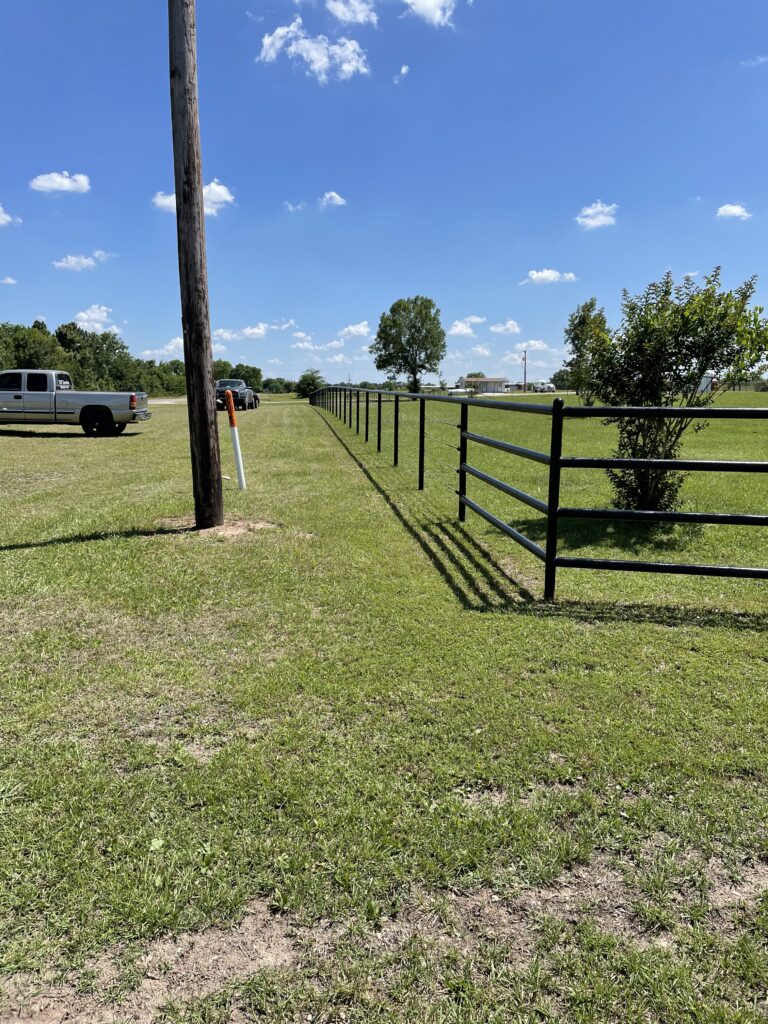
Pipe fencing is where 3H Construction started. Before we got into full-scale land clearing and excavation, we were building pipe fences — and we still do. There’s a reason pipe fence is the standard for livestock operations and serious property owners in this part of Texas: it lasts, it holds, and it doesn’t need constant attention.
We build pipe fence for perimeter boundaries, livestock containment, cross-fencing, and anywhere that a fence needs to take regular punishment and keep working.
Why Pipe Fence
If you’ve got cattle, horses, hogs, or other livestock, or if you’re on a property where you need a fence that won’t need to be replaced in five years, pipe fence is the right choice. It holds up to Texas heat and weather in a way that wire and wood alternatives don’t, and it doesn’t rust out the way thin-wall materials can.
It’s also a common request when people are clearing land and developing property — they get the clearing done, and then they need the boundary marked and secured before they bring livestock in or lease the grazing rights. We can often handle both in sequence.
What We Build
We build pipe fences for:
- Perimeter fencing around large parcels and ranches
- Livestock containment fencing for cattle and horses
- Cross-fencing to divide pastures
- Property boundary marking
- Residential and rural property security fencing
We use the right post spacing, depth, and pipe gauge for what the fence needs to do. A fence built for heavy cattle isn’t spec’d the same as a perimeter fence on a residential parcel.
The Connection to Dirt Work
Fencing and dirt work go together more often than people realize. When you’re buying new acreage and putting up a fence, you typically also need a gate entrance graded properly, a culvert placed at the road crossing, and sometimes a driveway put in. We do all of that, so you don’t have to call three different contractors to get a property ready.
Get a Free Estimate
Need pipe fence installed in the Richards, Huntsville, or College Station area? We offer free estimates.
Call (979) 571-8110 or fill out our contact form.
Pipe Fencing FAQs
Why choose pipe fencing over wire or wood fencing?
Pipe fence lasts significantly longer in this climate and holds up better against livestock pressure. It doesn’t rot, doesn’t get pushed through by cattle, and doesn’t require the same level of ongoing maintenance. For working ranches and serious agricultural operations, it’s the standard for good reason.
How deep do the posts need to be set?
Post depth depends on the soil type, the fence height, and the load the fence needs to handle. In most applications, posts go three feet or deeper. Clay-heavy soil and fence lines that will see heavy livestock contact may require deeper setting. We build to what the application calls for.
Can you build pipe fence on sloped or uneven terrain?
Yes. Most rural properties in this part of Texas have some slope and grade variation. We handle it — either by stepping the fence down grade or by racking sections to follow the terrain, depending on what works best for the location and the livestock involved.
How long does it take to install pipe fencing?
It depends on the total linear footage, the terrain, and the complexity of the line — corners, gates, and changes in direction all take additional time. Once we know the scope, we can give you a realistic estimate on time.
Do you install gates as part of the fence project?
Yes. Gates are typically part of a fence build. We discuss gate placement, size, and type as part of the planning before work starts.
Can you build pipe fence and do dirt work at the same time?
We handle both services, so yes — it’s very common for us to be doing clearing or grading on a property and building fence as part of the same project. Keeping it with one crew makes coordination simpler and often keeps the project moving faster.